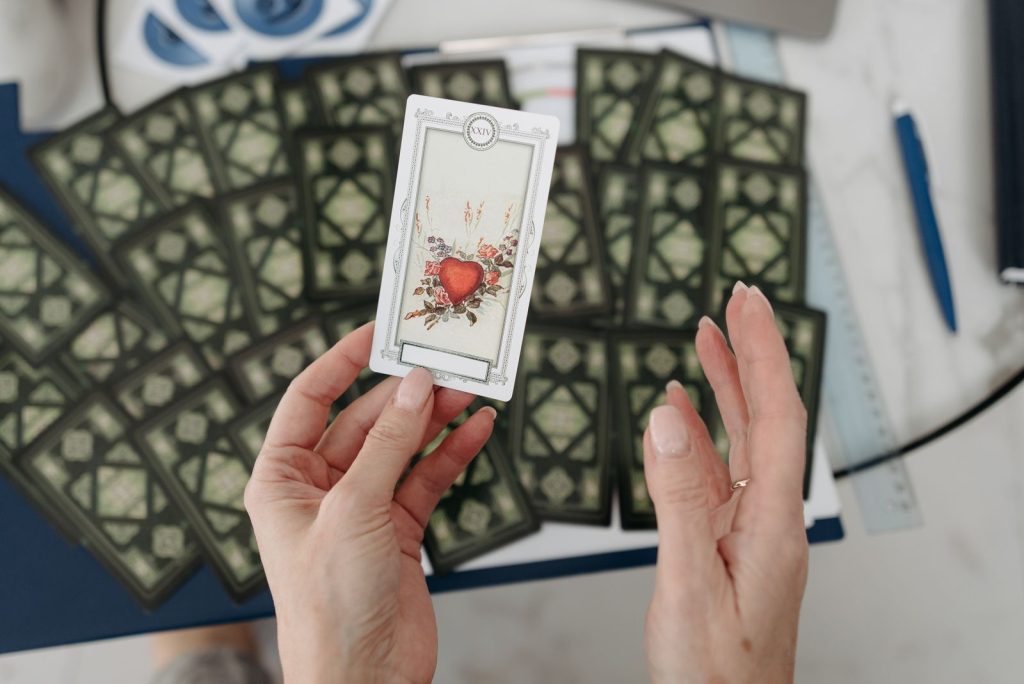
At first glance, a tarot deck can feel overwhelming. Seventy-eight cards, each with its own name, image and meaning. But the deck has a clear structure, and once you see it, learning the cards becomes much easier. This guide explains how the whole deck fits together.
Two parts: Major and Minor Arcana
“Arcana” means secrets or mysteries. The deck is divided into:
- The Major Arcana: 22 cards, numbered 0 to 21, about major life themes, lessons and turning points.
- The Minor Arcana: 56 cards in four suits, about everyday events, emotions, people and choices.
A useful way to think about it: the Major Arcana describes the chapters of your life story; the Minor Arcana describes the scenes within each chapter.
The Major Arcana
The 22 Major Arcana cards are often read as a journey, called the Fool’s Journey, from innocence to completion:
| No. | Card | Core theme |
|---|---|---|
| 0 | The Fool | New beginnings, spontaneity |
| I | The Magician | Skill, willpower, manifestation |
| II | The High Priestess | Intuition, hidden knowledge |
| III | The Empress | Abundance, nurturing, creativity |
| IV | The Emperor | Structure, authority, stability |
| V | The Hierophant | Tradition, learning, institutions |
| VI | The Lovers | Love, harmony, choices |
| VII | The Chariot | Determination, victory |
| VIII | Strength | Courage, patience, compassion |
| IX | The Hermit | Reflection, solitude, guidance |
| X | Wheel of Fortune | Cycles, change, fate |
| XI | Justice | Fairness, truth, consequences |
| XII | The Hanged Man | Pause, surrender, new perspective |
| XIII | Death | Endings, transformation |
| XIV | Temperance | Balance, moderation, healing |
| XV | The Devil | Attachment, temptation, limits |
| XVI | The Tower | Sudden change, revelation |
| XVII | The Star | Hope, renewal, inspiration |
| XVIII | The Moon | Uncertainty, dreams, illusion |
| XIX | The Sun | Joy, success, vitality |
| XX | Judgement | Awakening, reckoning, calling |
| XXI | The World | Completion, integration, travel |
Note that some decks swap the numbers of Strength and Justice (8 and 11). Both orders are traditional. Explore each card in our Major Arcana guides.
The Minor Arcana: four suits
Each suit has 14 cards: Ace to Ten, plus four court cards. Each suit is linked to an element and an area of life:
- Cups (water): emotions, love, relationships, intuition.
- Wands (fire): action, passion, creativity, ambition.
- Swords (air): thoughts, communication, decisions, conflict.
- Pentacles (earth): money, work, body, home, practical matters.
Some decks use different names: Chalices for Cups, Rods or Staves for Wands, Coins or Disks for Pentacles.
Numbered cards: Ace to Ten
The numbers follow a natural cycle from beginning to completion:
- Ace: a seed, a new opportunity.
- Two: balance, choice, partnership.
- Three: growth, collaboration.
- Four: stability, rest, structure.
- Five: challenge, conflict, loss.
- Six: harmony, recovery, generosity.
- Seven: reflection, assessment, testing.
- Eight: movement, mastery, change.
- Nine: near completion, fulfilment or intensity.
- Ten: completion, the end of a cycle.
Combine number and suit and you have the core of a card: a Five in Cups is emotional loss; a Five in Pentacles is material hardship; a Five in Wands is competition; a Five in Swords is conflict. See Tarot Numerology.
Court cards
Each suit has four court cards, representing personalities, roles or stages of maturity:
- Page: a student, a message, curiosity and beginnings.
- Knight: action and movement, sometimes impulsive.
- Queen: mastery expressed inwardly, nurturing and understanding.
- King: mastery expressed outwardly, leadership and control.
Court cards can represent other people, aspects of yourself, or approaches to a situation. Read more in Tarot Court Cards Explained.
How to learn the deck efficiently
- Learn the Major Arcana as a story, a few cards at a time.
- Learn the meaning of each suit and each number.
- Combine them to read the Minor Arcana without memorising every card.
- Study the court cards as personalities you know.
- Practise with a daily card and a journal.
Learning with the images
Most modern decks follow the Rider-Waite-Smith tradition, in which every numbered card shows a scene. These scenes are your best memory aid. When you see the Five of Cups, you see a cloaked figure mourning spilled cups while two cups still stand behind them. That picture tells you the meaning: grief over what was lost, and a reminder of what remains. Spend time simply looking at the cards before reading about them.
A memory trick for the suits
Link each suit to an everyday object. Cups are the glass you share with friends: feelings and connection. Wands are a burning torch: energy and drive. Swords are a pen or a sharp tongue: thoughts and words. Pentacles are coins in your pocket: money, work and the physical world. When an unfamiliar card appears, start with its suit’s object and number, and you will rarely be completely lost.
How the parts work together in a reading
In practice, the different parts of the deck give a reading its texture. Suppose you draw The Tower, the Three of Cups and the Knight of Pentacles. The Tower signals a major, unexpected change. The Three of Cups shows friends and celebration. The Knight of Pentacles brings slow, steady, reliable effort. Together, they might describe a sudden shake-up that is softened by the support of friends and handled through patient, practical steps. The Major card sets the stakes, the Minor cards fill in the details, and the court card shows the attitude that will help. Seeing the deck this way, as a set of complementary tools, is what turns 78 separate meanings into a language you can actually speak.
Frequently asked questions
Are Major Arcana cards more important?
They usually point to bigger themes, but Minor Arcana cards are just as meaningful for everyday questions.
Can I read with only the Major Arcana?
Yes. Many beginners start with the 22 Major cards before adding the rest. It gives you big, clear themes to work with while you learn, and you can add the suits one at a time later.
Why do some decks have different names?
Tarot has several traditions, including Rider-Waite-Smith, Thoth and Marseille styles. The structure stays the same even when names or artwork change, so what you learn on one deck carries over to most others.