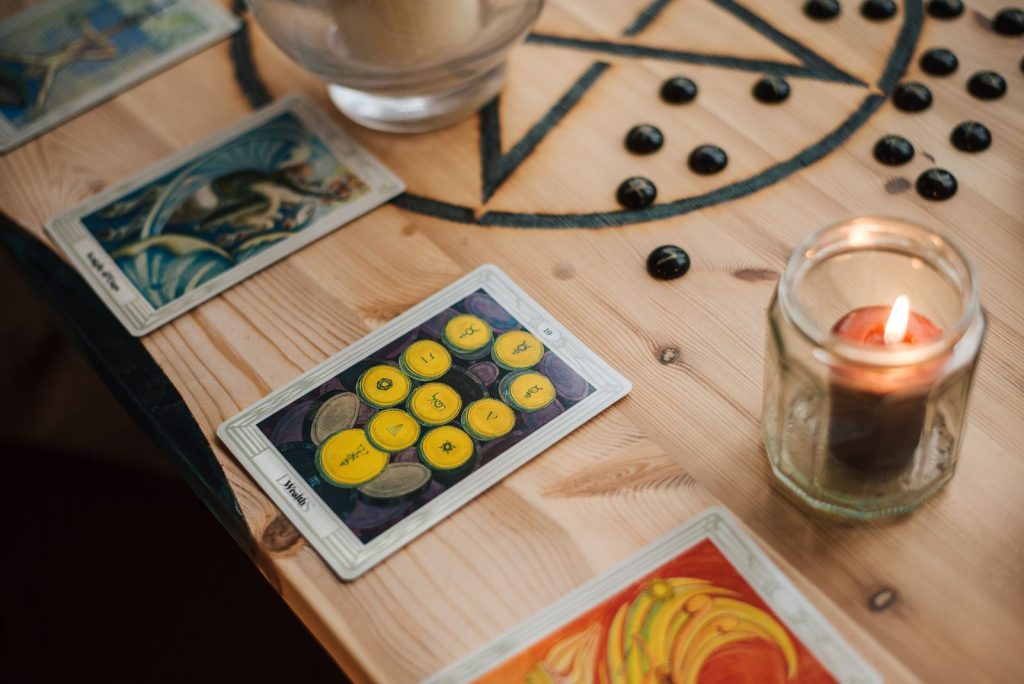
Free online tarot readings are everywhere: websites with a “shuffle” button, daily card emails, chatbots and AI tarot readers. They are a great way to explore tarot without buying a deck or paying a reader. But quality varies a lot, and some “free” readings are designed mainly to sell you something. This guide explains what to expect and how to get real value.

Types of free online readings
Automated card draws
The classic format: you click to shuffle, choose cards from a spread, and receive pre-written meanings for each card. Simple and quick, but the interpretation does not adapt to your specific question.
AI tarot readers
AI tools generate an interpretation tailored to your question and allow follow-up conversation. They are more personal than fixed meanings. See What Is AI Tarot Card Reading?
Daily card services
Websites, apps and newsletters that send one card each day with a short message. A gentle way to learn card meanings.
Free introductory readings from human readers
Some readers offer a short free reading or a free first question. These can be genuine, but they are usually designed to lead to paid sessions.
Community readings
Online tarot communities sometimes offer free practice readings from learners. These can be thoughtful and generous, and they help readers practise.
What free readings do well
- Accessibility: anyone can try tarot instantly.
- Learning: they introduce card meanings and spreads.
- Quick reflection: a card for the day or a simple, focused question.
- Privacy: some people prefer exploring tarot anonymously first.
Their limits
- Generic interpretations in fixed-meaning tools.
- Short, surface-level readings that skip how cards connect.
- Advertising and upselling interrupting the experience.
- Varying accuracy of card meanings on low-quality sites.
- Privacy trade-offs when sites collect data or emails.
Scams to watch for
Unfortunately, some services use free readings as a hook. Be cautious if you see:
- Claims that you have a curse, negative energy or bad luck that only a paid service can remove.
- Urgent warnings: “Something terrible will happen unless…”
- Requests for payment in gift cards, cryptocurrency or wire transfers.
- Pressure to share personal or financial information.
- Readers who contact you repeatedly after a free reading.
Legitimate readers and tools never use fear to sell. If something feels manipulative, leave.
Getting value from a free reading
- Ask a clear, open question. See How to Ask Good Questions.
- Read every card’s meaning carefully, then ask how it relates to your situation.
- Connect the cards into a story yourself, especially if the tool does not.
- Write down the reading and revisit it later.
- Take one action based on the insight.
Free reading vs your own deck
Online readings are convenient, but drawing your own cards offers something special: the shuffle, the touch, the time to look at the images. Many people start with free online readings, then buy a deck when they feel drawn to learn more. See How to Choose Your First Tarot Deck.
Signs of a good free tarot site
- Clear explanations of each card, including upright and reversed meanings.
- Information about how the reading works.
- A respectful tone without fear or pressure.
- A clear privacy policy.
- Reminders that tarot is for reflection and not professional advice.
- Educational content to help you learn.
Should you pay for a reading?
Paid readings with an experienced, ethical reader can offer depth and personal insight that free tools cannot. But you never need to pay to benefit from tarot. Free readings, your own deck and a journal can take you a long way. If you do pay, choose readers with clear prices, good reviews and an ethical approach.
How often to use free readings
A daily card or a weekly reading is usually plenty for most people. Drawing reading after reading on the same question leads to confusion rather than clarity. Give insights time to unfold.
A short example
Someone uses a free online three-card reading to ask, “How can I feel more motivated at work?” They draw the Four of Cups, the Page of Wands and the Three of Pentacles. The site shows a fixed paragraph for each card. On its own, that feels generic. But the person connects them: boredom (Four of Cups) can be answered by curiosity and a new small project (Page of Wands), ideally done with colleagues (Three of Pentacles). They decide to propose a small team initiative. The free reading became valuable because they did the connecting themselves, which is a skill any free tool can help you practise.
Free readings for learning
Free tools are one of the best ways to learn tarot without spending money. Use them as practice: before reading the site’s interpretation, look at each card and write what you think it means. Then compare. You can also use free daily card services as flashcards, noting each day’s card in your journal with your own interpretation. Over time, you will rely less on the site’s text and more on your own understanding, which is the real goal of learning tarot.
Combining free tools
Many people use more than one free resource: a daily card app for routine reflection, an AI reader for occasional in-depth questions, and a community forum for discussing confusing cards with other enthusiasts. Each has strengths. Combining them, while keeping your own judgement at the centre, gives you a rich tarot practice at no cost. Just remember to check each service’s privacy policy and avoid sharing personal details unnecessarily.
Frequently asked questions
Are free online tarot readings real?
They use real tarot meanings and random draws. Their value depends on how thoughtfully you reflect on them.
Why are some free readings so vague?
Fixed-meaning tools do not adapt to your question. AI tools or your own careful interpretation add the missing detail.
Is it safe to give my email for a free reading?
Only to sites you trust; expect marketing emails, and check how your data is used. A separate email address for newsletters and sign-ups can help keep your main inbox private.