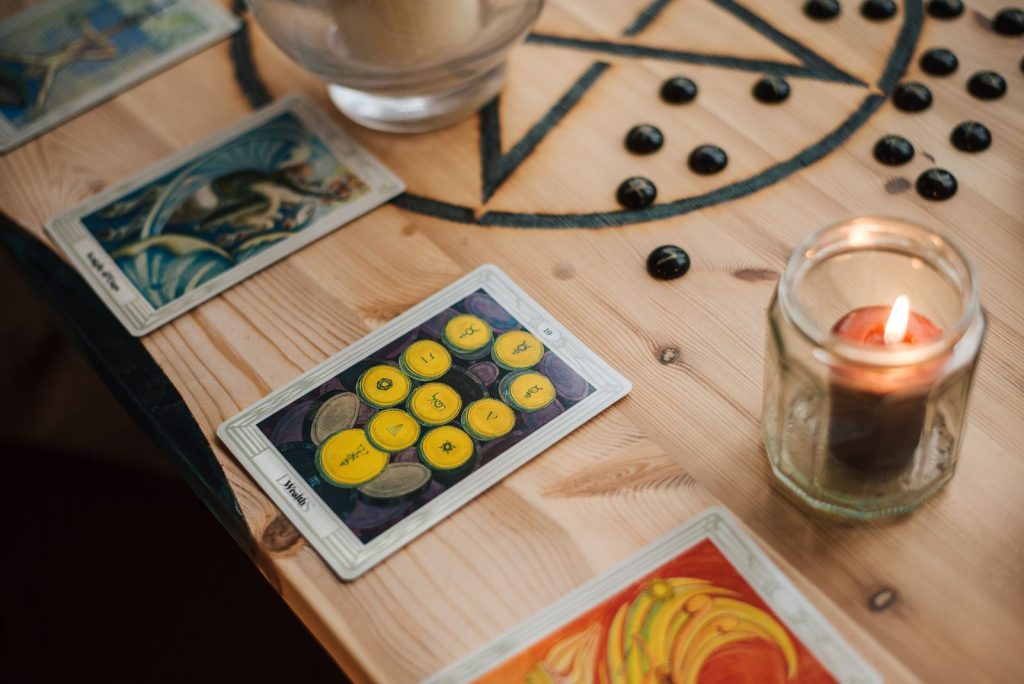
If you learn only one tarot spread, make it the three-card spread. It is quick, flexible and surprisingly deep. Three cards are enough to show a beginning, a middle and an end, or a problem, its cause and a solution. Professional readers use it every day, and beginners find it the easiest way to practise connecting cards into a story.
How it works
Lay three cards in a row from left to right. Before you shuffle, decide what each position means. The positions can change depending on your question, which is what makes this spread so versatile.
Ten three-card layouts
| Purpose | Card 1 | Card 2 | Card 3 |
|---|---|---|---|
| Timeline | Past | Present | Future |
| Problem solving | Situation | Action | Outcome |
| Balance | What helps | What hinders | Advice |
| Relationship | You | The other person | The relationship |
| Decision | Option A | Option B | What you need to know |
| Self-care | Mind | Body | Spirit |
| Goal | Where I am | What I need | Where I’m going |
| Communication | What I want to say | How it will be received | Best way to say it |
| Growth | Strength | Weakness | Lesson |
| Daily | Morning | Afternoon | Evening |
Reading the three cards together
- First glance: notice the overall mood, suits and any Major Arcana cards.
- Card by card: read each card in its position with one or two keywords.
- Connections: how does card one lead to card two? How does card three resolve them?
- Story: tell the reading as a short story in two or three sentences.
- Answer: return to your question and state the answer clearly.
Example 1: love
Layout: you, the other person, the relationship. Cards: Queen of Cups, Knight of Pentacles, Two of Cups.
You are caring, emotionally open and intuitive. The other person is steady and reliable, perhaps slower to express feelings. The relationship shows mutual attraction and balance. Story: a good match where your warmth meets their dependability; be patient with their slower pace, because the connection is real.
Example 2: career
Layout: situation, action, outcome. Cards: Seven of Pentacles, Page of Swords, Six of Wands.
You have worked hard and are waiting to see results. The action card suggests research, learning and asking questions, perhaps exploring new roles or skills. The outcome is recognition and success. Story: your patience is about to pay off if you actively seek new information and opportunities.
Example 3: decision
Layout: option A, option B, what you need to know. Cards: Ten of Wands, Three of Cups, Eight of Cups.
Option A brings heavy responsibility and potential burnout. Option B brings joy, community and support. What you need to know: you are ready to walk away from something that no longer fulfils you. Story: option B fits your emotional needs better; the Eight of Cups confirms it is time to move on.
Example 4: timeline
Layout: past, present, future. Cards: Five of Cups, Six of Swords, The Star.
A past loss or disappointment, a present transition away from that pain, and a hopeful future. Story: you are moving away from sadness towards healing; keep going, brighter times are ahead.
Tips for better three-card readings
- Choose positions before shuffling, not after seeing the cards.
- Use open questions, such as “How can I…” or “What do I need to know about…”.
- Don’t add extra cards just because you dislike the answer.
- Use a clarifier sparingly: if one card is unclear, draw one extra card for that position only.
- Write your story down to check it later.
Common mistakes
- Reading the three cards as unrelated messages instead of a connected story.
- Changing position meanings mid-reading to fit the cards.
- Asking yes-or-no questions with a timeline spread.
- Over-interpreting every detail; three clear points are enough.
Three cards with AI tarot
Many AI tarot tools use three-card spreads because they balance depth and clarity. If you use one, tell it which position meanings you want, and ask follow-up questions about how the cards connect. See How to Get a Better AI Tarot Reading.
Building from three
Once you are comfortable with three cards, you can expand naturally: add a fourth card for advice, or lay two rows of three for comparing options. Many larger spreads are built from three-card units. Mastering this spread prepares you for anything.
A practice routine
For one week, do a three-card reading every evening using a different layout from the table each day. Keep the question simple, write a two-sentence story, and check it against what actually happens over the following days. By the end of the week, you will know which layouts suit your style, and connecting cards will feel natural rather than forced.
Using a clarifier card well
Sometimes one card in a three-card reading feels unclear. A clarifier is an extra card drawn to explain that position only. Shuffle the remaining deck, ask “What else do I need to understand about this card?”, and place the new card beside the unclear one. Read the two together. Use clarifiers sparingly; if you add one to every card, the reading becomes cluttered and you may be avoiding a clear but unwelcome message. One clarifier per reading is a good rule.
Reading for someone else with three cards
The three-card spread is ideal for reading for friends because it is easy to explain. Tell them the positions before you turn the cards, ask them to focus on their question, and invite them to share what each card makes them think of. Their associations often add depth to your interpretation. Keep the final story short, and let them decide what to do with it.
Frequently asked questions
Is past-present-future the best three-card layout?
It is the most famous, but situation-action-outcome is often more useful for decisions.
Can I read three cards without fixed positions?
Yes. Some readers treat them as a sentence: subject, verb, object. It works well with practice.
What if all three cards are difficult?
Look for the advice within them and remember that tarot shows possibilities you can influence. Difficult cards often point to exactly what needs to change.