When you ask an AI tarot reader a question, you receive a fluent, personal-sounding reading in seconds. How does that happen? Understanding the technology helps you use AI tarot more wisely: you will know what it is good at, where it can go wrong and how to get better results. This article explains the main parts in plain language.
Part 1: drawing the cards
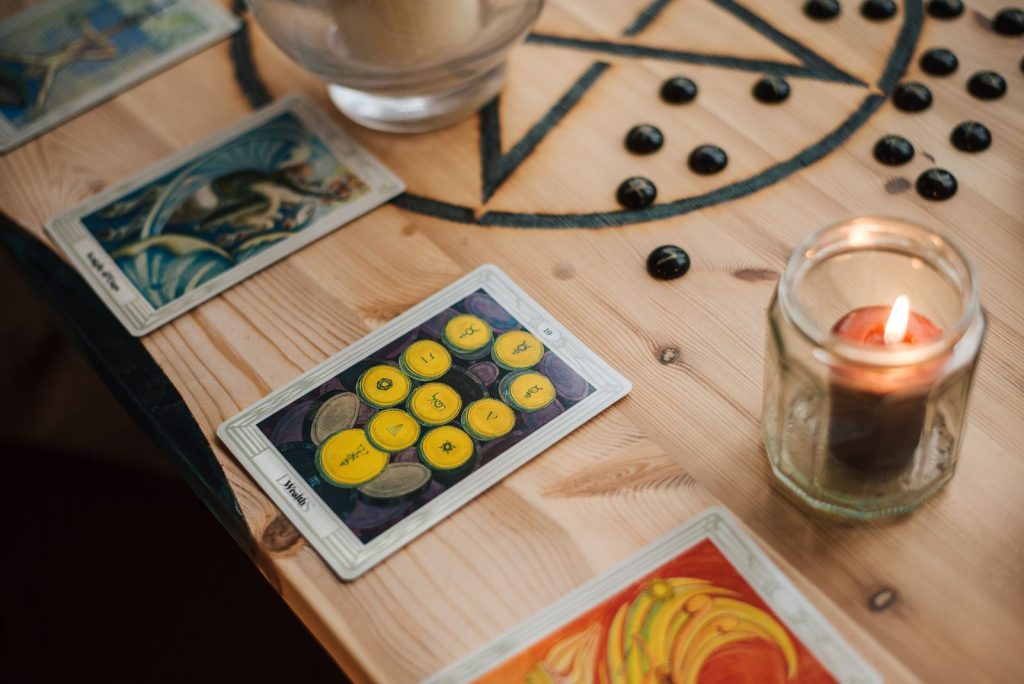
Most AI tarot tools start with a digital shuffle. The software uses a random number generator to pick cards from a list of 78, sometimes also deciding whether each card is upright or reversed. This is similar to how online games shuffle cards. Some tools let you “pick” cards by clicking on a face-down spread; behind the scenes, the cards are still assigned by randomness.
Other tools let you draw from your own physical deck and type in the cards. In that case, the AI only does the interpreting.
Part 2: the language model
The interpretation is generated by a large language model, an AI system trained on enormous amounts of text. During training, it has seen many descriptions of tarot cards, books about tarot, discussions of spreads and examples of readings. It learned patterns: which words and ideas tend to go with The Tower, how readers usually describe the Two of Cups, how a reading flows from one card to the next.
The model does not “know” tarot in the way a person does, and it does not perceive anything about you beyond what you type. It predicts, word by word, a response that fits the patterns it learned and the information you gave.
Part 3: instructions and prompts
Behind most AI tarot apps is a set of instructions, called a system prompt, written by the developer. It might tell the AI to act as a warm, ethical tarot reader, to explain each card in its position, to avoid predicting death or illness, to suggest professional help for serious issues, and to keep a particular tone. Your question, the spread and the drawn cards are then combined with these instructions and sent to the model.
This is why different AI tarot apps feel different even if they use similar underlying models: their instructions, spreads and style choices differ.
Part 4: spread logic
The app usually provides the meaning of each position: past, present, future; situation, obstacle, advice; and so on. The AI combines each card with its position and with your question. Better tools also prompt the AI to look at patterns, such as many cards of one suit or several Major Arcana cards, just as a human reader would.
Part 5: memory and follow-ups
In a conversation, the AI keeps the earlier messages in context, so it can answer follow-up questions about the same reading. Some apps also store past readings to offer journaling or track themes over time. This is convenient, but it raises privacy questions worth checking. See Privacy and AI Tarot Apps.
Why AI readings feel so personal
- Your question is woven in: the AI refers to your situation directly.
- Tarot language is broad: card meanings naturally fit many situations.
- Fluent writing: language models write in a warm, confident, human-like style.
The personal feel is real in the sense that the reading is tailored to your words. It is worth remembering, though, that the AI is reflecting your input back through tarot symbolism, not perceiving hidden facts about your life.
Where things can go wrong
- Telling you what you want: leading questions such as “Is he my soulmate?” can push the AI towards flattering answers.
- Confident errors: AI may occasionally give a wrong card meaning or mix up details.
- Vagueness: short questions without context produce generic readings.
- Overreach: poorly designed tools may make predictions about health or money that no reading should make.
What this means for you
- Give clear, open questions with honest context.
- Ask neutral questions rather than leading ones.
- Check card meanings against a trusted guide if something seems off.
- Use the reading as a mirror for reflection, not as a verdict.
- Keep important decisions in your own hands, with professional advice where needed.
Randomness and meaning
Some people wonder whether a computer’s random draw can be meaningful. Physical shuffling is also random from a physical point of view. Whether you believe the draw carries a deeper message or simply provides a useful prompt, the cards that appear invite reflection either way. The value comes from how you engage with them.
How developers design ethical AI tarot
Responsible AI tarot apps build in safeguards: they avoid fatalistic predictions, refuse to diagnose health conditions, encourage users in distress to seek real support, and remind users that tarot is for reflection and entertainment. They also explain how data is used. When choosing an app, look for these signs of care.
A simple comparison
| Step | Human reader | AI reader |
|---|---|---|
| Shuffle | Physical shuffle | Random number generator, or your own deck |
| Knowledge | Study and experience | Patterns learned from text |
| Intuition | Personal impressions | None; relies on your input |
| Interpretation | Spoken or written by the reader | Generated text tailored to your question |
| Follow-up | Conversation in session | Conversation in chat, any time |
Testing an AI reader yourself
A simple way to understand any AI tarot tool is to test it. Draw three cards from your own deck, write your interpretation, then enter the same cards and question into the tool. Compare the two. Then ask the same question again with different, more neutral wording and see how the interpretation changes. These small experiments quickly show you how much the reading depends on your input, and help you decide how much weight to give the tool’s suggestions.
Frequently asked questions
Does the AI see my future?
No. It interprets cards based on patterns in text and the information you provide.
Why do two AI apps give different readings?
Different draws, models, instructions and styles produce different interpretations.
Can I trust AI card meanings?
Usually they are accurate, but cross-check unusual claims with a reliable tarot guide.